


Brother… it’s Hot & Not Just Outside!
RED HOT Opportunities!
You don’t have to be the weather service to predict the weather this time. We all know… it’s the hottest time of the year. But that’s not all that’s hot. This is the season to buy and sell homes.
This is GOOD for most reading this, but there will be some exceptions. There always are. An example could be selling a house and making it out great, meaning a buyer pays a bit more than they would have not too long ago. And in some areas, the opposite happens. The Seller does not make out that great, but the buyer does. Most homeowners who do not have to know this will hold back on buying or selling. That will, of course, impact supply and demand. Results right now?
How does this impact you? Well, it is a HOT time to invest in real estate. Single-family, multi-family, even lofts. If you didn’t get the memo, here is a particular clause from our Buyer and Seller Agreements of our VIP Client Program, enabling past clients to create additional wealth through real estate.
VIP CLIENT PROGRAM: Seller _ does OR _ does not wish to participate in Broker’s VIP Client Real Estate Investor Program (REIP), whereby Seller will receive notices of free real estate investor training and notices of real estate investment opportunities by mail, email or phone at times when investment opportunities arise. The Seller may opt out of The REIP at any time. The Seller is never obligated to invest in real estate. So, if you or anyone you know likes making money in real estate using other people’s money, please contact The Corey Chambers Group immediately. While these HOT investment opportunities are available. Making gains in assets and wealth is nice! We especially like it because it allows us the opportunity to GIVE more. How about you?
As you probably know, we donate a portion of our income to some AMAZING, worthy causes, like Children’s Hospital of Los Angeles. It’s one of the country’s leading non-profit children’s hospitals. This year we are on a mission to raise $25,000 for CHLA. Their work in helping kids fight through and survive nasty debilitating diseases like cancer, non-Hodgkin’s lymphoma, and leukemia, as well as their work in other life-threatening childhood diseases.
At CHLA, they have performed first-of-its-kind surgeries to save local kids! As the leading not-for-profit hospital in L.A., you probably know they need sponsorships and donations to continue their leading-edge care and keep family expenses to a minimum. We are committed to donating a portion of our income from home sales to this worthy cause. So, YOUR REFERRALS really do HELP THE KIDS…
Who do you know is considering buying or selling a home or investing in real estate? Could you refer me to my team? Not only will they benefit from our award-winning service, but the kids at CHLA will also benefit. So call or pass my number on to anyone you know considering buying or selling.
My number is 213-880-9910. You and your referrals mean more than ever to my team and me. As we progress through this red-hot summer, please know we are incredibly thankful for you and a particular part of our business.
Your friends, neighbors, work associates, and family members who may be considering a move can now do so and celebrate true independence from the fear of getting stuck with two homes or none at all. And remember… Your referrals help the Children… As I share with you each month, we are on a mission to raise $25,000 for the Children’s Hospital Los Angeles Helping Hands Fund. We do this by donating a portion of our income. Children’s does excellent work in helping kids overcome cancer and other life-threatening diseases. In fact, Kids under their care are 300% more likely to enter into remission IF they can get into the recovery center. But CHLA depends on Sponsorships and Donations to keep rolling. So, YOUR REFERRALS REALLY DO HELP THE KIDS…
Who do you know considering buying or selling a home you could refer to my real estate sales team? Not only will they benefit from our award-winning service, but we donate a portion of our income on every home sale to Children’s Hospital Los Angeles Helping Hands Fund. In addition, I want to make it easy to refer your friends, neighbors, associates, or family members considering making a move, so here are your options:
1. You can go to www.ReferralsHelpKids.com and enter their contact info online or forward the link to who you know considering a move.
2. Of course, you can always call me directly at 888-240-2500.
You and your referrals mean more than ever to my team and me. So as we move forward in this new season, please know that my team and I are incredibly thankful for your being a particular part of our business.
With all my appreciation,
Corey Chambers, Broker
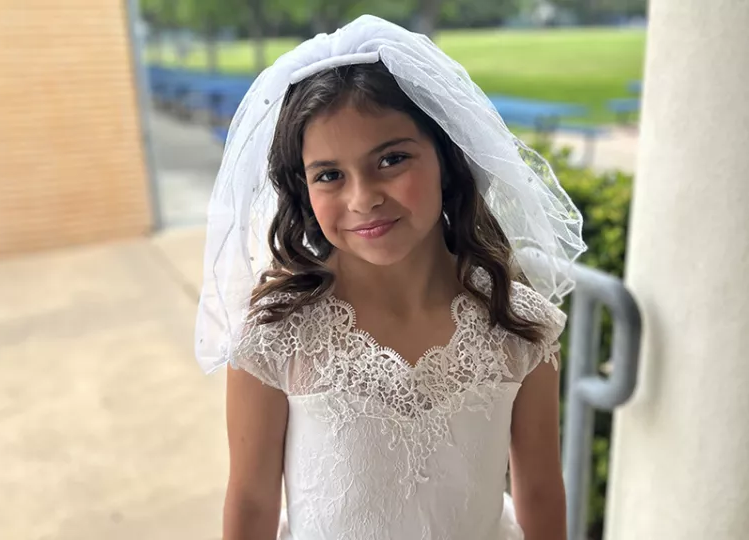
P.S. The story of this girl and her family may cause you to look at your loved ones differently. It did me. Check it out.
It’s easy to refer those you know considering buying or selling a home. Here are the Options Again:
You can go to www.ReferralsHelpKids.com and enter their contact info online or forward the link to someone you know considering a move.
Call me direct or pass my number on:
213-880 9910.
Why I Support Children’s Hospital of Los Angeles
I grew up right here in Los Angeles. Born right nearby at St. Francis Hospital. I remember hearing about a young person close to our family suffering from a serious illness and getting treated for that at Children’s Hospital Los Angeles. Then, I began to pay more immediate attention to their work at that hospital. Since then, I have learned that it is a collection of hard-working health care professionals, most making their homes right here in the Los Angeles area, all coming together for a common cause. That cause is to help young people overcome unfortunate health issues that life sometimes throws our way. Being a Los Angeles area, California native, I take pride in supporting in any way that I can the good work these people do at Children’s. My team rallies around our annual goal of raising money and donating portions of our income to help Children’s Hospital in its quest to heal young people when they need healing. My team and I are committed to providing outstanding results for buyers and sellers referred to us by our past clients. I have discovered that Children’s Hospital Los Angeles shares similar commitments to its patients. And since their services survive sponsorships and donations, we are happy to contribute and proud to support them.
A New Bladder and a Transplanted Kidney Means All Systems Go for Olivia
Olivia needed her entire urinary tract restored. Her parents trusted doctors at Children’s Hospital Los Angeles to pull off the most complex procedures and give her life. — by Jeff Weinstock

Rachel Lestz, MD, didn’t relish what she was having to do. But as a nephrologist treating the most extreme renal problems in children, she understood that being the target of blame-the-messenger was an unavoidable hazard of practicing medicine.
“When I’m telling a family that their child is going to need dialysis, is going to need a kidney transplant—all the dreams and hopes that they had now have to shift,” says Dr. Lestz, Medical Director of Pediatric Kidney Implantation at Children’s Hospital Los Angeles. “I always say to families, ‘You may have a very bad association with me because I shared this with you, and that’s OK.’ It’s a normal thing.”
On this occasion, in November 2013, she had to inform Claudia that her newborn daughter, Olivia, who had been airlifted to Children’s Hospital Los Angeles at 13 days old, was in kidney failure and would eventually need a kidney transplant to save her life. “She was born without enough kidney function, effectively,” Dr. Lestz says.
As often happens, Claudia connected Dr. Lestz to the diagnosis and resented her for delivering it, even though Dr. Lestz tried forcefully to explain that a solution was available.
“I remember her saying ‘kidney failure’ and I just shut down,” Claudia says. “She was trying to get me to stop crying and to hear her, saying, ‘She will be OK. We’re going to get her through this. She will be OK.’ But all I heard was she wasn’t OK and someone interrupting me, and I was like, ‘Oh, she is not nice.’ She was definitely not my favorite doctor at the time.”
And now? “We love her to this day.”
Building a new bladder
Olivia’s kidney weakness was one piece of an undeveloped urinary tract that included the absence of a bladder, creating an obstruction that doomed the whole system, as the kidney had nowhere to deposit the urine it produced.
The discovery came soon after Olivia was born, alongside her fraternal twin sister, Mia, a bit early at 36 weeks. Olivia went home while Mia needed a few extra days in intensive care to resolve some breathing difficulties.
Things reversed when they were back in their Santa Barbara home. Mia got stronger and began to develop, while Olivia didn’t eat well and had little energy. Claudia took her back to the hospital, where blood work and multiple other tests produced a shock: Olivia had only one kidney and it was full of disease.
“I was in disbelief, just distraught,” Claudia says. “I thought she was my healthy child.”
To relieve the pressure in the kidney, the immediate intervention taken at CHLA was a nephrostomy tube. The procedure sidesteps the bladder altogether. A catheter is placed directly into the kidney to collect urine and carry it away through an opening created in the patient’s back, draining into an external bag that gets emptied manually. It’s short-term fix, since the presence of a catheter, or any foreign instrument, in the body brings a risk of infection.
“We try to get that out as soon as possible,” says Evalynn Vasquez, MD, CHLA’s Associate Chief of Urology.
The next level up is a cutaneous ureterostomy, in which doctors redirect the ureter, a tube that in healthy urinary tracts sends urine from the kidney to the bladder. In cases such as Olivia’s, with a malfunctioning or absent bladder, doctors bring the ureter to the skin, where it leaves through a tiny hole made in the belly and leaks into a diaper the patient wears.
In spring 2014, Olivia underwent surgery, which maintained her for five years. Late in 2019, her kidney function bottomed out, necessitating a transplant.
But a new kidney needed to partner with a bladder. Since Olivia didn’t have one, one would have to be built before the transplant could happen. Creating a “neobladder” is a major surgical improvisation that Dr. Vasquez, Director of CHLA’s Complex Reconstruction and Malformations Program, says is done regularly on adult bladder cancer patients, but rarely on kids.

“In pediatrics, it’s not very common for patients to not have a bladder,” Dr. Vasquez says, noting she had performed the procedure several times on adults. “Olivia was the first in a pediatric patient that I had done.”
Using tissue taken from Olivia’s bowel, Dr. Vasquez crafted a makeshift bladder—essentially a pouch to catch the urine from the soon-to-be transplanted kidney. She then had to construct a passageway—called a Mitrofanoff after the doctor who devised it—to funnel urine from the new bladder to the skin, where it could be siphoned off by a catheter through an opening in the abdomen, called a stoma. Dr. Vasquez discreetly created the stoma in Olivia’s belly button so it wouldn’t be visible. Olivia, now 9 years old, inserts the catheter herself to empty the neobladder every few hours.
“The goal was to have her live essentially a normal life,” Dr. Vazquez says. “To have her not have any difficulty catheterizing, and to able to be dry and wear regular underwear and not get any urinary tract infections—you’re holding your breath and waiting to see how she does.”
The procedure’s success depended on whether Olivia would be able to self-catheterize without difficulty, without fear and while keeping dry. Olivia, only 6 at the time, picked up on the task so quickly, Dr. Vasquez asked her to share her skills.
“I told her, ‘Olivia, you have to teach all my patients how to do this because you’re so good at it.’ I have another patient who was born without a bladder, and I’ve connected them so they can talk, so she can be a support system for her.”
A donor, then a dog
After the procedure Olivia went on dialysis, a machine which carries out the waste-removal functions that failing kidneys can no longer execute. Her priority level on the waiting list for a transplant rose. Within six weeks, on Jan. 30, 2020, Claudia got word that a donor was found.
“I was at the kids’ school,” Claudia says. “I took the call while I was volunteering in the classroom, and one of the moms looked at me and I was like, ‘Oh my gosh, I think we have a match.’”
On the following day, Olivia’s new kidney, accompanied by a new ureter, was installed and connected to the neobladder. Her urine can now pass between the two organs, travel down the Mitrofanoff that leads to the hole in her bellybutton, where Olivia catheterizes every few hours to drain the bladder. All the surgical engineering is internal and allows Olivia to live without wearing a diaper.
“All you see on her is just this big scar on her stomach where her surgery was,” Claudia says, “Nobody has to know she has a pouch.”
The only outward sign of the entire apparatus is the grin she wears.
“This little girl and her spirit are so remarkable,” Dr. Vasquez says. “I’ll never forget, I saw her in the preop area and she was so excited. She sees me and says, ‘Dr. Vasquez, I’m getting a kidney!’
“She’s done so well, and it’s amazing how she’s survived everything she’s been through.”
Dr. Lestz sees Olivia monthly to monitor her new kidney. “Her kidney function’s actually normal,” Dr. Lestz says, “even for her age three years post-transplant.”
It’s a long way from the start of Olivia’s life, when Claudia and her husband, Jesus, were uncertain of her survival. “We had an emergency baptism for her,” Claudia says. “We called our priest and he came to the ICU.”
The one area of struggle has been eating. After taking her food since infancy through a gastrostomy tube inserted in her belly, Olivia is working to overcome her fears of eating by mouth, though nothing medically prevents it.
“Otherwise, she’s great,” Claudia says. “She’s thriving, happy, loves her friends. She has this amazing light. She brings joy to all of us.”
That includes her siblings, who received their own reward when Olivia got her transplant.
“We told the kids that after Olivia got a transplant they could have a dog, so they related her getting a kidney transplant to getting a dog. They were very excited: ‘Oh my gosh, we’re getting a dog!’ We looked at them like, ‘What?’ And they were like, ‘You said, when Olivia gets a transplant we could have a dog.’ We forgot about that arrangement completely.”
In the background, the loud barking confirms that mom and dad made good on the deal. All in all, it was a bargain. — Story and photos courtesy Children’s Hospital Los Angeles
Learn more about the Division of Abdominal Organ Transplantation at Children’s Hospital Los Angeles.
Refer your friends, neighbors, associates, or family members who are considering making a move:
www.ReferralsHelpKids.com or call Corey at 213-880-9910
Copyright © This free information is provided courtesy of L.A. Loft Blog and LAcondoInfo.com with the information provided by Corey Chambers, Broker, DRE#01889449. We are not associated with the homeowner’s association or developer. For more information, contact (213) 880-9910 or visit LAcondoInfo.com, Licensed in California. All information provided is deemed reliable but is not guaranteed and should be independently verified. Properties are subject to prior sale or rental. This is not a solicitation if the buyer or seller is already under contract with another broker.


You must be logged in to post a comment.